
15 Corporate Social Responsibility Initiatives That Work
Three out of four companies surveyed in CECP’s 2026 research run some kind of sustainability program. Yet the share of employees who actually take part in company giving and volunteering has barely moved in years.
So having a program isn’t the hard part anymore. Picking one that people use, and that you can show results for, is.
This guide walks through real corporate social responsibility initiatives, grouped by type, with examples from big companies and ideas a 50-person team could start this month. If you’re already leaning toward something simple, you can start a free company shoe drive here.
What is a corporate social responsibility initiative?
A corporate social responsibility initiative is a specific program a company runs to have a positive effect beyond its own profits. That can mean reducing waste, supporting the local community, investing in employees, or changing how the business sources and sells its products.
The word “specific” matters. “We care about the planet” is a value. “We collect our employees’ old shoes every quarter and report the pairs diverted from landfills” is an initiative. People can join an initiative, and you can measure it.
The four main types of CSR initiatives
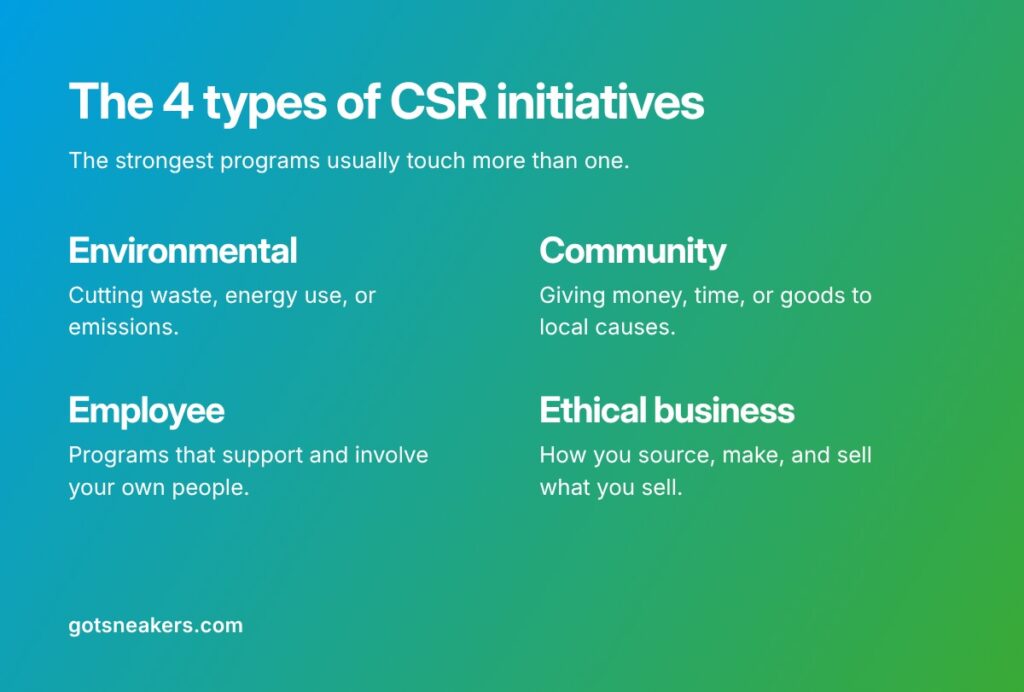 Most corporate social initiatives fall into one of four buckets:
- Environmental: cutting waste, energy use, or emissions
- Community: giving money, time, or goods to local causes
- Employee: programs that support and involve your own people
- Ethical business: how you source, make, and sell what you sell
The strongest programs usually touch more than one. A shoe drive, for example, is an environmental initiative that employees run together and that can raise money for a local cause.
Three CSR initiative examples from well-known companies
1. Salesforce’s 1-1-1 model
Salesforce commits 1% of its equity, 1% of its technology, and 1% of its employees’ time to social good. It also co-founded Pledge 1%, which invites companies of any size to commit some share of their time, product, profit, or equity. The lesson for smaller companies is that the percentage doesn’t have to be big. It just has to be written down.
2. Patagonia’s Worn Wear trade-in
Through Worn Wear, Patagonia buys back used gear in good condition for store credit so it stays in use and out of the landfill. It’s a good example of an initiative tied directly to what the company sells. If you make or sell physical products, ask what happens to them at the end of their life.
3. Optum’s employee shoe program
Optum runs a program with GotSneakers where employees send in used footwear to extend its life and help raise funds for charity. Employees sign up for a free account, fill a collection bag, ship it for free, and receive an eCheck and an impact summary. It’s an easy model to copy because it asks employees for something they already have.
Environmental CSR initiatives
4. Start a footwear collection program
Most old sneakers still have life left, and GotSneakers partners have kept 5.35 million pairs out of landfills so far.
With GotSneakers, your company gets free collection bags and prepaid shipping labels. Gently worn pairs go on to be worn again, and you get a monthly Environmental Impact and Earnings Report with your own totals.
Every pair kept in use averts about 30 pounds of CO2e, roughly what it takes to make a new pair.
5. Set up real office recycling
Most offices have a paper bin and not much else. Add clear bins for the things your team actually throws away, and post what goes where. Our upcoming guide to office recycling ideas will cover this in more detail.
6. Cut single-use items
Swap disposable cups, plates, and utensils in the break room for reusable ones. It’s a small change people notice every day, which makes it a good first step before bigger commitments.
7. Plan an Earth Day push
April 22 gives you a deadline and a reason to talk about results. Share your year-to-date impact numbers and set a goal for the rest of the year.
Community CSR initiatives
8. Run a staff giving campaign
A set window, a clear goal, and more than one way to give. Our guide to staff giving campaign ideas covers how to get more of your team involved, including options that don’t ask anyone for cash.
9. Schedule team volunteer days
Food bank shifts, park cleanups, and build days give employees a way to give time together. For options that fit a busy work week, see these team building volunteer ideas.
10. Partner with one local nonprofit
Picking one organization and supporting it all year can do more good than spreading small amounts across many. Ask them what they need most, whether that’s money, volunteers, or a specific item.
11. Donate your shoe drive payout
If you run a collection with GotSneakers, your company receives an eCheck for eligible footwear. Donating it to a cause your employees vote on turns one initiative into two: less waste and a cash gift.
Employee CSR initiatives
12. Offer volunteer time off
Give employees a set number of paid hours each year to volunteer on their own. It costs little to set up and lets people support causes they already care about.
13. Match employee donations
CECP found that 94% of the companies it surveyed offer at least one matching-gift program. If you already have one, promote it. If you don’t, a simple 1:1 match up to a cap is a common place to start.
14. Start a green team
Two or three volunteers who own your sustainability efforts can keep a program alive long after launch. Our post on keeping employees engaged in sustainability all year has a month-by-month plan.
Ethical business CSR initiatives
15. Look at what you buy and what you throw away
Review your biggest purchases and your biggest sources of waste. Swapping a supplier, buying refurbished equipment, or donating used furniture instead of trashing it are all initiatives you can measure and report.
How to choose the right corporate responsibility initiative
You don’t need fifteen. Start with one or two that pass these tests.
- It fits your business. Patagonia’s trade-in works because Patagonia sells gear. Look for an initiative connected to what you do or where you are.
- Employees can actually join. If it only works for people with a free Saturday, most of your team will sit it out.
- You can measure it. Pick an initiative that produces a number, like pairs diverted, dollars donated, or hours volunteered.
- Someone owns it. Every initiative that lasts has one person keeping it moving.
Common mistakes to avoid
Mistake: Announcing a big goal with no plan behind it.
Fix: Launch something small you can deliver, then build from there.
Mistake: Making claims you can’t back up.
Fix: Only report numbers you can verify. Programs that send you real totals, like a monthly impact report, make this much easier.
Mistake: Treating CSR as a once-a-year event.
Fix: Pick an initiative that runs year-round, and tie updates to moments like Earth Day and the holidays.
Mistake: Never telling employees what happened.
Fix: Share results. People join again when they can see what their effort added up to.
FAQs about corporate social responsibility initiatives
What are examples of CSR initiatives?
Common examples include recycling and collection programs, employee volunteer days, donation matching, staff giving campaigns, and partnerships with local nonprofits. Salesforce’s 1-1-1 model and Patagonia’s Worn Wear trade-in are two well-known examples.
What is a good CSR initiative for a small business?
Start with something that costs little, involves employees, and produces a number you can share. A shoe drive, a staff giving campaign, or a quarterly volunteer day all fit.
What are the four types of corporate social responsibility?
Environmental, community, employee, and ethical business initiatives. Many strong programs combine two or more.
How do you measure a CSR initiative?
Choose one or two numbers before you launch, such as pairs of shoes diverted, dollars donated, or volunteer hours, and report them on a regular schedule. GotSneakers partners get a monthly Environmental Impact and Earnings Report with their own totals.
How do you get employees involved in CSR?
Ask what causes they care about, offer ways to take part that fit a normal work week, and share results. Initiatives that only work outside work hours tend to reach the same small group.
Can a CSR initiative raise money for charity?
Yes. A shoe drive with GotSneakers, for example, pays an eCheck for eligible footwear that your company can donate. The earnings guidelines explain what qualifies.
Start with one initiative your whole team can join
The CSR initiatives that last are the ones people can join easily and see results from. A company shoe drive is free to sign up for, fits into a normal week, and comes with monthly numbers you can put in your next report.