Staff Giving Campaign Ideas Your Team Will Join
Here’s a number that should change how you plan your next staff giving campaign.
On average, only about 21% of employees take part in their company’s matching-gift program, and about 25% join volunteer programs, according to CECP’s 2026 research on corporate giving. Those numbers have barely moved in years. CECP also found that a lot of the same employees show up in both groups.
So most giving campaigns reach the same committed few, and everyone else sits it out.
If you’re looking for staff giving campaign ideas that get more of your team involved, this guide covers what works, how to run a campaign start to finish, and the mistakes that kill participation. If you already know you want an easy one, you can start a free shoe drive here.
What is a staff giving campaign?
A staff giving campaign is a set window of time when a company invites employees to give back together. That can mean donating money, collecting items, volunteering, or some mix of the three.
The good ones have a clear goal, a deadline, and a way for people to see what their effort added up to. Most companies run one around the holidays, and many add a second push in spring or around Earth Day.
Why participation stalls
Most campaigns ask for one thing: money. That’s a real barrier right now. CECP found that median employee contributions dropped 14%, which tracks with how tight household budgets are.
Plenty of people want to help and simply don’t have an extra $50 this month. When cash is the only way to take part, they sit it out.
The fix is to give people more than one way in. Some will give money. Some will give an hour. And a lot of people will happily give something they already own and no longer use.
8 staff giving campaign ideas that get more people involved
1. Run a shoe drive
Almost everyone has a pair of sneakers they’ve stopped wearing, which makes a shoe drive one of the easiest asks you can make. Nobody has to spend a dollar.
With GotSneakers, your company gets free collection bags and prepaid shipping labels. Gently worn pairs go on to be worn again, and your company receives an eCheck for eligible footwear along with a monthly Environmental Impact and Earnings Report. Your team can donate the payout to a local charity, which turns old shoes into a cash gift on top of the environmental impact.
What qualifies: athletic shoes and casual sneakers, in pairs. Boots, heels, wedges, dress shoes, water shoes, and single shoes can’t be accepted. The earnings guidelines have the full list.
2. Hold a matching-gift month
If your company already matches donations, pick one month to promote it hard. Plenty of employees forget the match exists. A reminder email, a simple how-to, and a running total on the intranet can bring in people who never knew they could double their gift.
3. Collect for a specific need
Coats in November, school supplies in August, and toiletries for a local shelter any time of year. A specific ask works better than “donate anything” because people can picture who it helps. Call the organization first and ask what they actually need right now.
4. Organize a volunteer day
Sorting food at a food bank or packing kits at a local nonprofit gives people a way to give time instead of money. Smaller companies tend to see higher volunteer participation than large ones, so don’t assume you’re too small to pull one off. Our post on turning a shoe drive into a monthly program covers how to keep that kind of momentum going after the first event.
5. Offer an in-office option for people who can’t leave
Not everyone can take an afternoon off for a volunteer day. Card-writing for seniors, assembling care kits in the break room, or a collection bin by the elevator let people help without leaving their desk for long.
6. Let employees vote on the cause
Give your team three charities and let them vote. People show up for a cause they picked. Announce the winner, then report back on what the campaign raised or collected for it.
7. Make it a friendly competition
Department vs. department or office vs. office works well, especially across teams that don’t usually talk. Post the standings halfway through. Keep the prize small, like a team lunch, since the bragging rights do most of the work.
8. Tie it to Giving Tuesday
Giving Tuesday falls on December 1 this year. It’s a natural deadline for a holiday campaign, and it gives you a reason to send a final reminder the week of Thanksgiving.
How to run a staff giving campaign, step by step
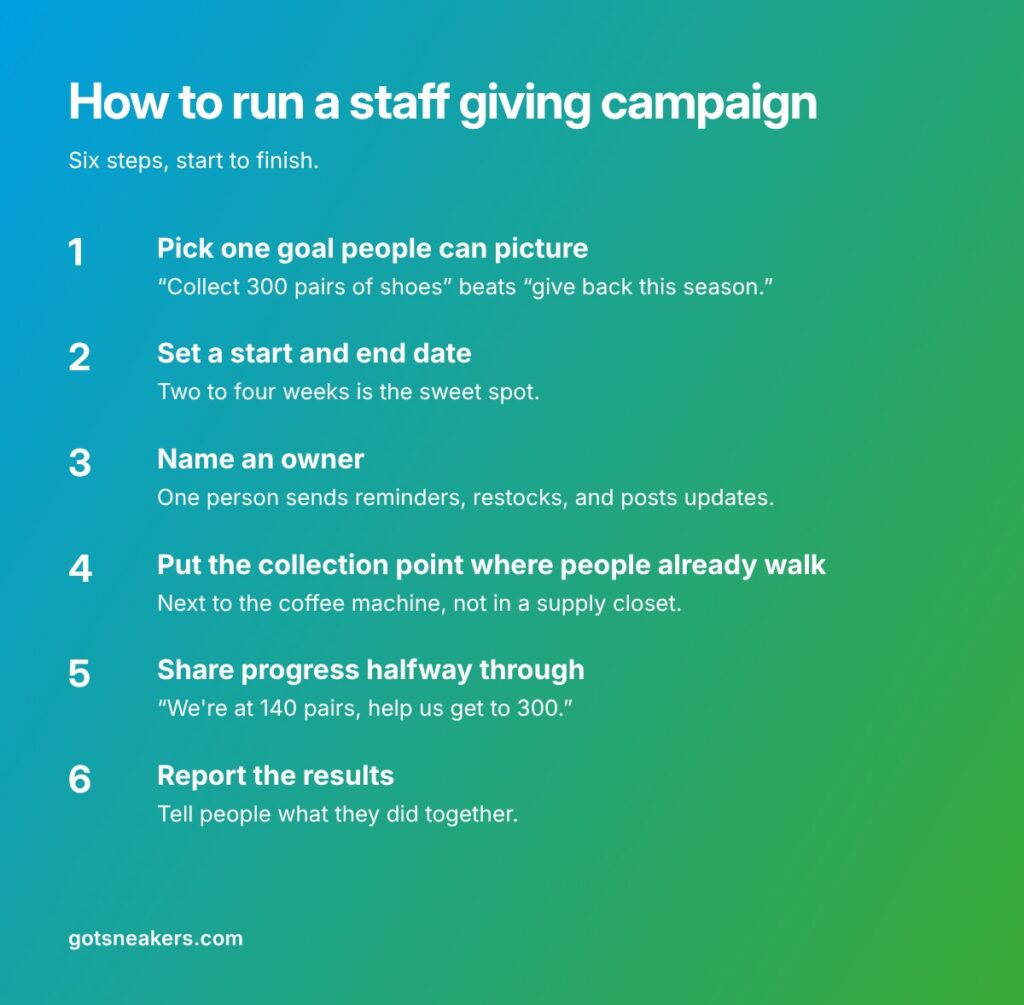 Step 1: Pick one goal people can picture
“Collect 300 pairs of shoes” or “fill 50 care kits” is easier to rally around than “give back this season.” Pick a number your team can realistically hit, then beat.
Step 2: Set a start and end date
Two to four weeks is the sweet spot. Shorter feels rushed and longer loses energy. Put the end date on every sign and email.
Step 3: Name an owner
Every campaign that works has one person keeping it moving. They send the reminders, restock the supplies, and post the updates. For a shoe drive, that also means shipping full bags with the prepaid labels and ordering more bags before you run out.
Step 4: Put the collection point where people already walk
A bin in a supply closet gets forgotten. A bin next to the coffee machine, the elevator, or the front desk gets used.
Step 5: Share progress halfway through
A midpoint update in Slack, the company newsletter, or the break room screen gives people a reason to act again. “We’re at 140 pairs, help us get to 300” works better than a generic reminder.
Step 6: Report the results
This is the step most campaigns skip, and it’s the one that makes the next campaign easier. Tell people what they did together. With a GotSneakers shoe drive, your monthly report shows the pairs your team sent in and their environmental impact. Every pair kept in use averts about 30 pounds of CO2e, roughly what it takes to make a new pair, so 300 pairs is roughly 9,000 pounds of CO2e kept out of the air.
Common mistakes to avoid
Mistake: Asking only for money.
Fix: Offer at least one way to take part that costs nothing, like an item drive or an in-office activity.
Mistake: Running the campaign with no end date.
Fix: Set a two- to four-week window so people have a reason to act this week.
Mistake: Collecting items the charity can’t use.
Fix: Ask the organization what they need before you launch, and post clear rules for what qualifies.
Mistake: Going quiet when it ends.
Fix: Share the final numbers and thank people by team. That’s what brings them back next year.
FAQs about staff giving campaigns
What is a good staff giving campaign idea for a small company?
An item drive is usually the easiest place to start, since it doesn’t need a budget or a big time commitment. A shoe drive works well because nearly everyone has a pair they’ve stopped wearing.
How long should a workplace giving campaign run?
Two to four weeks. That’s long enough for people to participate and short enough to keep the energy up.
How do you get more employees to participate?
Give people more than one way in, set a clear goal and deadline, and share progress halfway through. Campaigns that only ask for cash tend to reach the same small group every year.
When is the best time to run a staff giving campaign?
The holidays are the most popular time, with Giving Tuesday as a natural deadline. Spring cleaning season and Earth Day are good times for a second campaign.
Can a shoe drive raise money for charity?
Yes. With GotSneakers, your company receives an eCheck for eligible footwear, and you can donate it to a cause your team chooses. The earnings guidelines explain what qualifies.
How do we show employees the impact of their donations?
Share a short update with the totals, such as dollars raised, items collected, or pairs diverted from landfills. GotSneakers partners get a monthly Environmental Impact and Earnings Report that makes this easy. For more ideas, read how to keep employees engaged in sustainability all year.
Start your campaign with a shoe drive
The campaigns that get the most people involved give them an easy way to help. A shoe drive asks for something your team already has, is free to sign up for, and comes with numbers you can share when it’s done.
Bags take a little time to arrive, so if you’re planning a holiday campaign, sign up a couple of weeks before your start date.